Water sports attract people for many reasons: physical challenge, connection with nature, adrenaline, and the satisfaction of mastering a demanding skill. Among the most dynamic disciplines is canoe polo (often called kayak polo), a fast-paced team sport that blends paddling technique with ball control, tactical movement, and intense coordination. Even if you’ve never watched a match, canoe polo is easy to appreciate once you understand what it demands: athletes must handle a kayak with precision while simultaneously passing, defending, and shooting under pressure.
Canoe polo is played on a defined stretch of flat water, often outdoors on lakes or calm rivers and sometimes indoors in pools. Each team typically fields five players, and the objective is to score by getting the ball into a suspended goal above the water. That one detail—an elevated goal—shapes the entire sport. Players must pass quickly, move into position, and time their shots while controlling their kayak’s momentum. The combination of elevation, water movement, and contact makes every possession a tactical puzzle.
The skill set in canoe polo is unusually broad. First, athletes need excellent paddling fundamentals: acceleration, stopping, turning, and maintaining balance while changing direction rapidly. Second, they need ball handling—catching, throwing, and passing accurately while sitting in a narrow boat. Third, they need team tactics: spacing, switching roles, reading opponents, and managing time. And because contact is part of the sport, players must also understand safe physical play and how to protect themselves.
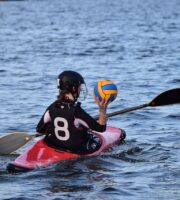
Equipment is designed specifically for this environment. Canoe polo kayaks are typically shorter and more maneuverable than touring kayaks, enabling tight turns and quick pivots. Paddles often have reinforced edges for durability and control, and protective gear is essential. Helmets and face protection reduce injury risk during close contact, while buoyancy aids, boat bumpers, and appropriate clothing support both safety and performance. In competitive sports, equipment choice doesn’t replace skill, but it can amplify it—especially in a sport where agility and rapid movement matter.
Training for canoe polo is not only about strength; it’s also about efficiency. A powerful stroke matters, but timing and technique matter more over a full match. Conditioning usually includes interval work, because the sport features bursts of sprinting followed by short recoveries. Core strength is critical for stability and rotation. Shoulder and back conditioning supports repetitive paddling motions. Meanwhile, hand-eye coordination drills build the ball skills needed for accurate passing and controlled shooting.
Team training is where canoe polo becomes especially interesting. A team must develop shared habits: when to press, when to fall back, how to communicate, and how to respond when possession changes suddenly. Players need to trust each other’s positioning, especially in the “zone” area near the goal, where defensive structures are built to block attacks. Good teams don’t rely on one star—they rely on coordinated movement and quick decision-making.
Safety culture is also a core part of water sports in general, and canoe polo is no exception. Because the sport involves contact and boats, athletes must learn safe tackling angles, how to avoid dangerous paddle contact, and how to respect refereeing decisions. Proper warm-ups reduce injury risk, and good coaching emphasizes technique and control rather than reckless aggression. For new athletes, the first goal should be confidence in the water: reliable rolling skills (or safe exits), strong balance, and comfort with close-quarters movement.
Canoe polo also shares benefits with other paddling disciplines: improved cardiovascular fitness, stronger upper body endurance, and sharper mental focus. Water sports demand attention. Wind, water texture, and changing angles all force athletes to stay present. That “in-the-moment” mindset is a major reason people fall in love with paddling sports. You’re not just exercising—you’re responding to a moving environment.
In the bigger picture, canoe polo represents what makes water sports special: they combine athleticism, technique, and community. The learning curve is steep, but the progress is satisfying. You go from basic paddling to controlled maneuvers, from messy passes to accurate play, from individual effort to team strategy. Whether you train casually or pursue competition, canoe polo offers a unique way to build fitness, discipline, and teamwork—while enjoying the energy of sport on the water.